LeetCode 3367. Maximize Sum of Weights after Edge Removals
Problem Statement
You are given an undirected, weighted tree.
Try to remove zero or more edges such that:
- Each node has an edge with at most k other nodes, where k is given.
- The sum of the weights of the remaining edges is maximized.
Example
Input: edges = [[0,1,4],[0,2,2],[2,3,12],[2,4,6]], k = 2
Output: 22
Explanation:
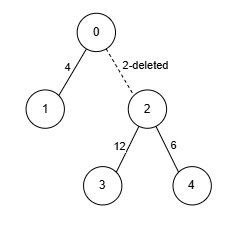
Constraints
- \(2 <= n <= 10^5\) .
- \(1 <= k <= n - 1\) .
- \(1 <= edges[i][2] <= 10^6\) .
Explanation
We can solve this problem using dynamic programming on trees.
We define the state
\(dp(current node, parent node)\) state
with two values: \(v1\) and \(v2\).
- \(v1\) represents the the maximum achievable sum when the current node is allowed to connect with at most \(k-1\) children.
In this case, one connection slot is reserved for linking the current node to its parent.
- \(v2\) represents the maximum achievable sum when the current node is allowed to connect with up to \(k\) children, meaning no connection slot is available for the parent.
Transition:
How to get current state’s \(v1\)?
We can use priority_queue-like datastrcture to keep track of the previous selecting and regret if we have better choice.
Or we can firstly sum up the subanswers and regret with sorting improvements.
We sum up all the children’s \(v1\), and we can have more slots if the selecting children has better \(v2\).
Then, we have one more slot if calculating \(v2\).
Complexity
Time: \(O(nlg(n))\).
Space: \(O(n)\).
</> Code
1
2
3
4
5
6
7
8
9
10
11
12
13
14
15
16
17
18
19
20
21
22
23
24
25
26
27
28
29
30
31
32
33
34
35
36
37
38
39
40
41
42
43
44
45
46
47
48
49
class Solution {
 public:
  int64_t maximizeSumOfWeights(vector<vector<int32_t>>& edges, int32_t k) {
    int32_t n = static_cast<int32_t>(edges.size()) + 1;

    // Transform the input to adjacency list.
    vector adj(n, set<pair<int32_t, int32_t>>());
    for (auto& edge : edges) {
      int32_t u = edge[0], v = edge[1], w = edge[2];
      adj[u].insert({v, w});
      adj[v].insert({u, w});
    }

    // DFS the potential states.
    // return two values:
    // v1 means current node only connects at most k-1 children.
    // v2 means current node connects at most k children.
    auto dfs = [&](auto&& self, int32_t cur_node,
                   int32_t parent_node) -> pair<int64_t, int64_t> {
      int64_t res = 0;
      vector<int64_t> improvements;

      for (auto [next_node, weight] : adj[cur_node]) {
        if (next_node == parent_node) continue;
        auto [child_v1, child_v2] = self(self, next_node, cur_node);
        res += child_v2;
        int64_t improvement = max(0L, child_v1 + weight - child_v2);
        improvements.push_back(improvement);
      }

      sort(improvements.rbegin(), improvements.rend());
      int64_t sum_v1 = res, sum_v2;
      for (int i = 0;
           i < (k - 1) and i < static_cast<int32_t>(improvements.size()); i++) {
        sum_v1 += improvements[i];
      }

      if (static_cast<int32_t>(improvements.size()) >= k) {
        sum_v2 = sum_v1 + improvements[k - 1];
      } else {
        sum_v2 = sum_v1;
      }

      return {sum_v1, sum_v2};
    };

    return dfs(dfs, 0, -1).second;
  }
};